Insights into the World of Brand Associations
What does your
brand truly stand for?

Brands don't live in glossy brochures, but in the minds of customers.
An analysis of 72 brand spaces from B2B and B2C shows which associations truly shape brands – and why “good quality” alone is rarely enough to stand out from the competition.
What comes to mind spontaneously when you think of your own brand? And what do your customers answer to the same question? There is often a surprisingly large gap between these two answers – and precisely in this gap lies strategic potential. Because a brand is not what a company communicates about itself, but the image that forms in the minds of customers.
How We Look into the Minds of Customers
To make this image visible, we use the method of free association: Respondents spontaneously state what comes to mind about a brand – without guidelines, without answer categories. The typical question is simply: “What comes to mind spontaneously when you think of [Brand X]?” Possible answers range from concrete product features to diffuse feelings.
To transform these individual responses into reliable insights, we condense them into a structured brand space in three steps.
3 Steps
From Spontaneous Association to Structured Vergès Matrix
The content dimensions of brand meaning are captured through spontaneous associations. Each respondent can (typically) name up to five associations.
What comes to mind when you think of Brand X?
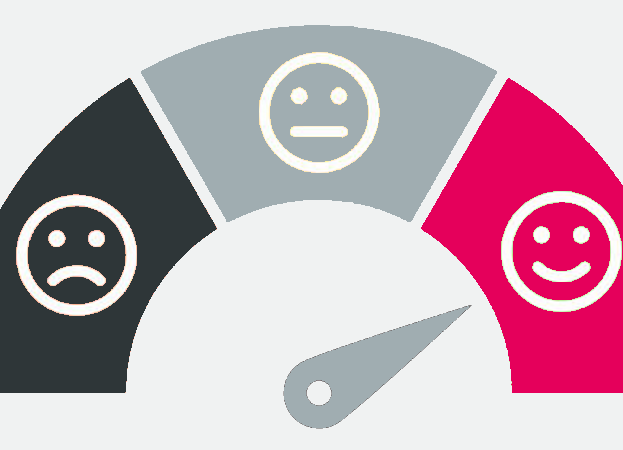
Additionally, respondents can rate each association on a school grade scale from very positive to very negative.
The entire spectrum of responses is subjected to content analysis.
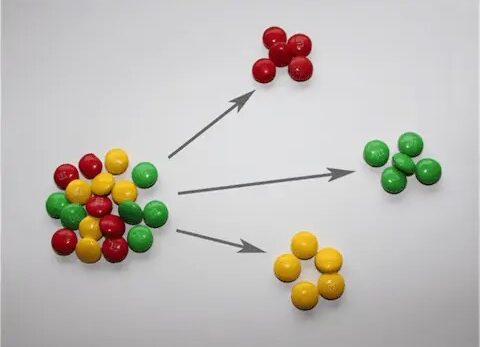
Individual associations are captured by content. Those with similar meanings are grouped into categories. These association categories are subsequently used for the Vergès Matrix.
In the Vergès Matrix, association categories are ordered by their relative frequency and average rank.
This is supplemented by the average rating of the respective association.
The Brand Space: Core and Periphery
The result is the Vergès Matrix: It organizes all mentioned associations according to two dimensions – how frequently and how early they are mentioned. Associations that many respondents name spontaneously and first form the core of the brand. They are stable, defining, and difficult to change. Everything mentioned less frequently or later belongs to the periphery – more interchangeable and highly situation-dependent.
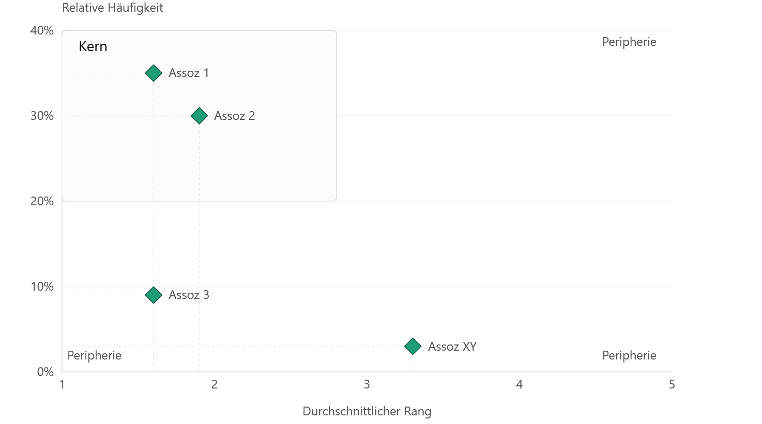
This structure makes brands comparable: Because the survey is standardized, it is possible to precisely determine how differentiated a brand is actually positioned – and which associations make it distinguishable from competitors.
What 72 Brand Spaces Reveal
Our analysis of 72 brand spaces from B2B and B2C reveals a clear pattern: Quality is the dominant top association – for 94% of the B2B brands examined, it is one of the two central core concepts. At first glance, this is reassuring, but at second glance, it’s a warning sign: If almost every brand primarily stands for quality, how distinguishable is it actually from the competition?
B2C brands show a more heterogeneous picture: Only 10% of consumer brands can have their brand core described with just two associations. Here, industry-specific topics often matter – for hotels, for example, culinary offerings, location, and relaxation. Overall, the most important core associations can be condensed into four categories: Quality, Price, Service/Consulting, and Design.
The Connection to Recommendations
The analysis becomes particularly insightful when linked to the Net Promoter Score®. Brands with a high NPS® have a significantly more dominant top association (average 47% relative frequency) than brands with a low NPS® (36%). A clear, widely shared positioning demonstrably increases the willingness to recommend.
The effect is even clearer with negative associations: They appear in only 14% of brand spaces with a high NPS®, but in 82% of brand spaces with a low NPS®. And even between promoters and critics of the same brand, the mentioned associations differ noticeably – critics more often perceive the brand as interchangeable, while promoters significantly more often name a concrete benefit.
What This Means for Your Company
Brand associations are not a gut feeling, but measurable – and they provide concrete starting points for brand management: Where is our brand core clear enough? Where do we rely too much on interchangeable attributes like “good quality”? And how do the images in the minds of our most loyal customers differ from those of our critics?
Those who answer these questions with reliable data instead of assumptions can steer positioning, communication, and product development much more precisely – and consciously sharpen their own brand core instead of leaving it to chance.
Do you know what your brand truly stands for in the minds of your customers?
Using the Vergès Matrix, we visualize which associations shape your brand core – and show concrete approaches to sharpen your positioning.