Should Strategy and Action Be Separated?

In his article "Keep Strategy Simple" in the Harvard Business Review on August 27, 2024, Graham Kenny provides a number of interesting recommendations:
Distinguish strategy from actions.
Develop strategies only for the entire organization.
Do not develop strategic plans for functions, but rather stakeholder-oriented strategies.
Avoid terms like “Strategic Plan” or “Marketing Strategy” to prevent misunderstandings.
Should we follow Kenny's recommendations?
A plan is a defined sequence of activities intended to achieve a goal. Since unexpected developments almost always occur, planning is the replacement of chance with error, which enables organizational learning. In contrast, a strategy is a guiding framework that defines an organization’s direction of development, the scope of action on the path to the desired positioning of the organization, and the rules of the game to be observed. A strategy provides an organization with dynamic stability; that is, sufficient flexibility to react to changing circumstances without abandoning the path to the intended positioning. The term “strategic planning” is therefore an oxymoron and should be avoided.
As Kenny says, strategy always represents a type of positioning because it defines the “For Whom,” “What,” “How,” and “Where.” In larger organizations, however, strategies exist at multiple hierarchical levels. Comparable to the principle of the Matryoshka doll, the overall organization’s strategy dictates the fundamental pattern to be followed. It is the largest of the dolls. Within this, following Kenny’s logic, there are then positionings relative to individual stakeholders. In contrast to Kenny, however, we also advocate for frameworks for functional areas, such as marketing or human resources. But, and here we agree with Kenny, this should not be understood as a collection of measures. A marketing strategy as a framework includes the positioning to be achieved, as well as the rules of conduct in the individual areas of the marketing mix. These form the basis for the coordinated deployment of necessary activities to achieve goals. Therefore, strategy cannot be considered completely separate from activities, as Kenny seems to demand.
What the author does not address is the realization of a strategy. This does not occur after strategy development. Separating the processes of strategy development and implementation corresponds neither to business reality nor is it advisable.
An organization’s strategy continuously evolves: consciously within a process and/or unconsciously through the implicit actions of organizational members in response to changes in the macro, micro, and internal environments. This is based on data that organizational members collect and interpret regarding the content of the strategic framework. Resulting measures can reinforce the intended positioning, but also alter it.
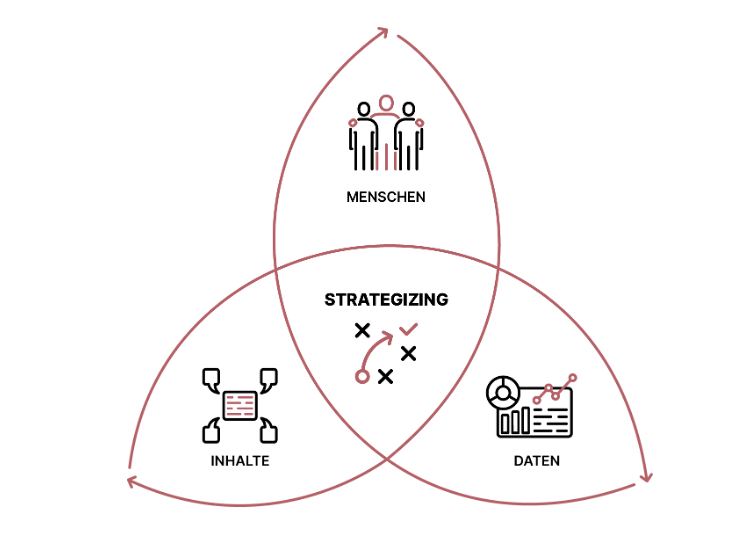
This process, in which strategic content, data deemed relevant, and human action are closely intertwined, is what we at IMARK call “Strategizing.” Thus, strategy and action continuously interact and are closely linked – similar to Yin and Yang, which are in a reciprocal relationship and form an eternal cycle.
The integrated design of this strategizing process is crucial for an organization’s sustainable success.