Stability of
Brand Associations
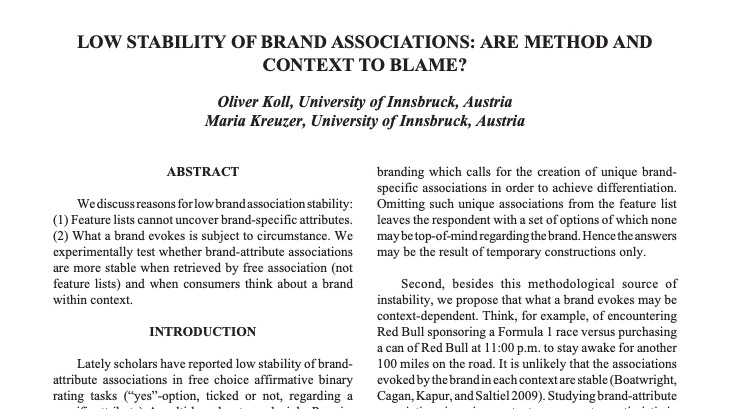
Oliver Koll and Maria Kreuzer highlight two reasons that may be responsible for the low stability of brand associations:
(1) the method used and
(2) the context.
Regarding the method: The authors compare lists of category-specific attributes with free associations. Lists of category-specific attributes only partially correspond to the fundamental idea of brand management. This is because brand management focuses on creating unique, brand-specific associations to differentiate a brand from its competitors.
Regarding the context: Associations are context-dependent. If you ask a person why they decided one way and not another in a specific situation, the answer is often: “It depends on the situation.” Accordingly, the associations linked to a brand can also vary depending on the context.
Recommendations for Brand Managers:
It is important to understand which associations are evoked only temporarily and which are evoked permanently in different contexts.
While free associations are less stable, the greater number of associations evoked allows for a better understanding of unique and potentially long-term brand associations.
Differences in the associations of various customer groups—such as in terms of region, socioeconomic characteristics, as well as attitude and loyalty to the brand—can provide a basis for better reaching previously untapped customer segments.