What we think about brands has a strong influence on our brand preferences.
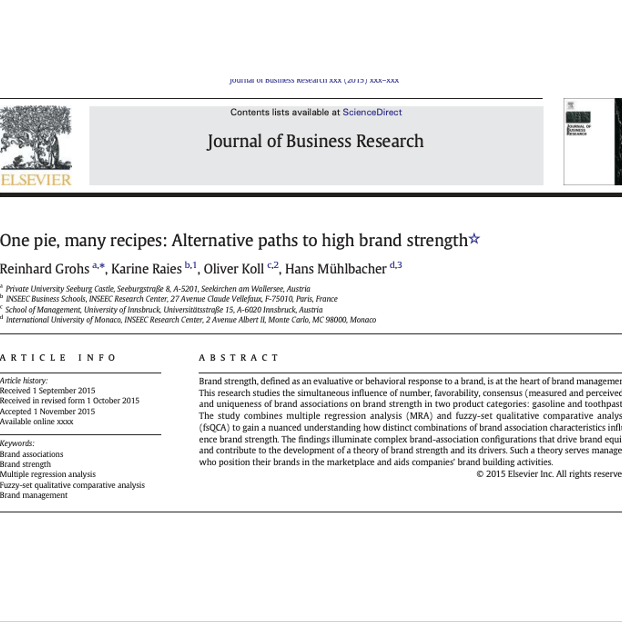
This study examines how the number of brand associations, their valence, uniqueness (compared to other brands), and perceived similarity (of one’s own associations with those of others) collectively influence brand strength in two product categories (gas stations and toothpaste).
The study compares the results of a multiple regression analysis (MRA) with those of a fuzzy-set qualitative comparative analysis (fsQCA) to understand how different combinations of the aforementioned association characteristics influence brand strength.
The results indicate that high brand strength is not the simple result of more or less (e.g., more associations are better, unique associations are worse, etc.), but can result from different configurations of these factors. Independent of this specific study, an analysis of causal relationships using fsQCA provides insights into potentially previously unrecognized configurations of drivers—and highlights paths that may lead to a specific result more cheaply, in a more differentiated manner, or more effectively for certain target groups.