Segmentation is considered one of the central building blocks of market-oriented strategy development – yet in practice, it often fails due to the same stumbling blocks.
A survey of 50 decision-makers from Austria and Germany reveals the benefits companies gain from segmentation, how they actually proceed – and where the challenges lie.
Not every customer is the same – yet many companies still treat their market as a homogeneous mass. From our perspective, segmentation is one of the central building blocks of market-oriented strategy development. In a survey of 50 decision-makers from Austrian and German companies, we investigated how segmentation is actually implemented in practice – and where the biggest stumbling blocks lie.
What Benefits Does Segmentation Provide?
From the perspective of the surveyed decision-makers, a diverse picture emerges: The greatest benefits of segmentation are seen in target group-specific communication and efficient market cultivation, in more focused product development, in a better understanding of customer needs, and in the management of sales and field service. For some respondents, segment formation is also a prerequisite for overall better planning and more efficient resource allocation.
This breadth shows: Segmentation is not purely a marketing task. It has a significantly broader scope and should be understood as a general approach to foster awareness of customer commonalities and differences throughout the entire company – from product development to sales.
How Companies Segment in Practice
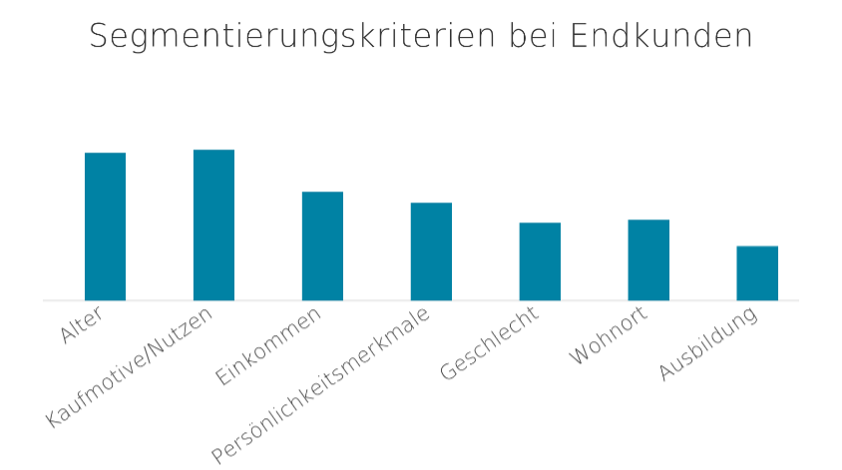
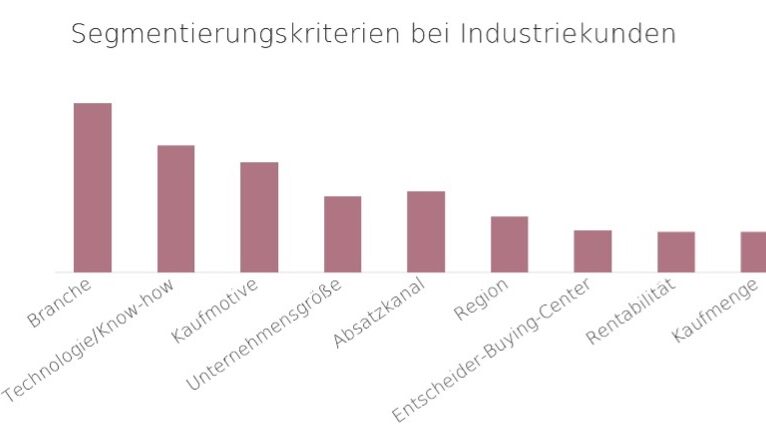
The choice of segmentation criteria differs significantly between B2B and B2C. For industrial customers, industry, technology or know-how, and the desired benefit are paramount. For end customers, however, sociodemographic criteria such as age and income dominate, along with purchasing motives and benefit expectations.
Nearly half of the respondents state that their existing segmentation solution dates back four or more years – but for most, a critical review was conducted less than three years ago. Segmentation is therefore not a one-time project, but a continuous process that must be regularly re-evaluated.
Awareness is Half the Battle – Communication is the Other Half
More than half of the respondents state that every employee is familiar with the existing segments – an encouraging value, as awareness is the basic prerequisite for segment-specific action. To embed this knowledge, companies rely on regular employee meetings, segment-specific training, informational materials, and active internal communication.
The Biggest Stumbling Blocks in Practice
Segmentation is not a mathematical process with clear-cut results. The decision-makers we surveyed primarily name four recurring challenges: the clear delineation of segments, often complicated by cross-segment customer groups; lack of internal understanding and scarce resources; the fear of excluding potential customers; and an unclear or missing definition of the demarcation criteria.
Segments, as one respondent aptly put it, are often comparable to clouds – there are no sharp boundaries, the transitions are fluid. Customers can certainly belong to several segments simultaneously in different situations.
What This Means for Your Company
To reflect market dynamics in existing segmentation solutions, regular market research activities are needed to keep customer needs, expectations, and benefit perceptions up-to-date. Those who understand segmentation as a continuous, company-wide process – rather than a one-time marketing project – lay the groundwork for more focused products, more efficient market cultivation, and sales management that truly addresses customer needs.
Do you truly know the relevant segments of your market?
We support you in data-based delineation of customer groups, their internal anchoring, and continuous adaptation to market dynamics.