Positioning Decision

A "clean" (meaning accurate and honest) segment evaluation should identify those segments where a company, based on its capabilities, is able to meet the benefit expectations of typical customers better than competitors.
However, it is unlikely that this applies to all customer benefit expectations within the segment. We are not aware of any company that is superior to the (still existing) competition in all respects. But that is also not necessary for successful market cultivation.
It is enough to fulfill more or more important benefit expectations better than the competition. Imagine a purchasing decision for a consumer good that is important to you (e.g., a bicycle, a cell phone, or a vacation trip): your ideal offer would probably be a combination of parts from several providers (e.g., the design from provider X, the functionality from Y, and the price from Z), but this does not exist in that way. The final selection is made by weighing relative strengths and weaknesses.
Customers and potential customers have a certain perception of these strengths and weaknesses and thus form an image of the company—they position it. Knowledge of this position is indispensable for a company’s management: knowing why customers choose your company, whether this decision is easy or difficult, or why they decide against your company, provides security: security regarding what you can (and cannot) promise, security regarding where you can realistically (and cannot) develop, and security regarding how you can differentiate yourself sustainably.
For this reason, the following questions should be asked regularly:
Why do we believe we can be more successful in a segment than others? On what capabilities is this belief based? Are we doing enough to maintain these capabilities? Which weaknesses must we eliminate to avoid the risk of being overtaken by the competition?
How do our customers see us? What are the strengths attributed to us? What concrete benefits do customers derive from these strengths?
Do our employees at all touchpoints know enough about our strengths? Are they therefore able to reinforce our position in the minds of our market partners? Or do we leave our employees in the dark—causing them to send signals that are inconsistent with what is supposed to distinguish us?
Focus
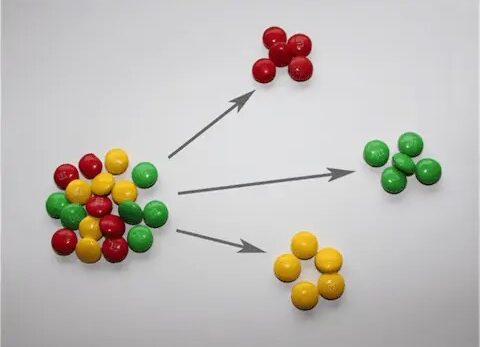
Positioning means focusing—being clear about the fact that you cannot offer everything to all potential customers. No company can achieve that, and those who try quickly run the risk of blurring their position: market partners experience conflicting signals and are no longer able to categorize the company. As a result, it is no longer top-of-mind when customers are searching—searching for the most competent provider, the fastest delivery, or the most appealing design. Companies that do not serve customer requirements better than others (at least in some areas) will soon not be allowed to serve any at all. Therefore, it is important to stop potential fragmentation in time by having the organization concentrate on what distinguishes it. This means consciously not actively working parts of the market, while approaching others all the more deliberately.
Segmentation and segment evaluation are not ends in themselves, but the way to enable this focus. Based on an intensive analysis of customer needs and a comparison of one’s own capabilities with those of the competition, those target groups are identified where the company is most likely to score points. These should then be served as a priority: by maintaining particularly intensive relationships (to receive feedback), optimizing services for these groups (to be able to serve them better), and explaining this focus to employees (to ensure their buy-in).
Focus
The following questions lead to more focus:
-
Do employees know what the company wants to stand for (and for which customer groups)? Is it communicated to employees why this is the case and why this position is attractive and promising?
-
Are there incentives to reward this focus? In other words: what is being done to ensure focus and avoid fragmentation?
-
Are there sufficient touchpoints with customers (and other relevant system partners) to be “close to the market” (e.g., experience exchange groups, complaint management, market information systems, sales force-customer interaction, etc.)?
Concretization at all touchpoints
Using knowledge of one’s own strengths and weaknesses for focused market cultivation is one side; making this position tangible for potential market partners is another. Companies that succeed in consistently communicating their desired position at (ideally all) touchpoints find it easier to anchor it in the minds of their exchange partners. Inconsistent appearances are undesirable: one wonders why a certain brand is sold at X, why Y advertises for a certain brand, or why product Z is launched on the market.
Concretization means “getting to the point,” making the position tangible and experiential. This must not stop at the development of a specific slogan, even if a good slogan can express a lot, such as the claim of the luxury vacation destination Fisher Island (Where people who run things can stop running) or Legal Seafood restaurants in New England (If it’s not fresh it’s not legal).
An organization sends signals at all touchpoints that are interpreted by everyone who comes into contact with the brand (in the sense of Watzlawick’s statement: “One cannot not communicate”). Identification, evaluation, and design of these touchpoints are the central steps of successful strategy implementation. The following questions help with this:
CONCLUSION
Positioning means conscious restraint, both in terms of content (What benefit do we want to offer?) and target audience (Whom do we want to serve?). The concern about potentially forgoing (short-term achievable) revenue is understandable. The danger of losing a clear and attractive profile through too little (or wrong) focus, and also losing sustainably achievable revenue, is much greater.