The work surrounding “Objectives and Key Results” (OKRs) in the organizational and consulting landscape is extensive, particularly regarding the agile transformation of organizations and the consistent implementation of strategies.
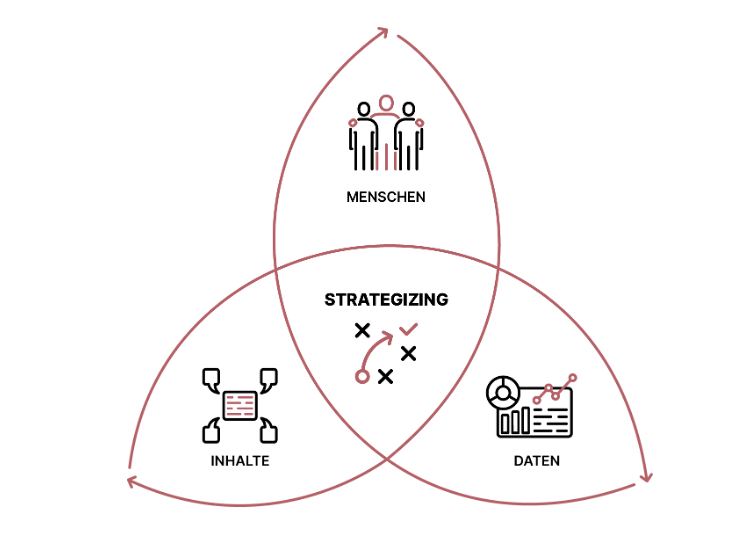
OKRs are a management tool that primarily does one thing: breaks down the corporate strategy into digestible goals and measurable results, thereby integrating the broad topic of strategy into everyday operations. Working with OKRs builds upon strategic content, the underlying data for measuring goal achievement, and people with an agile mindset.
The Formulation Is Key
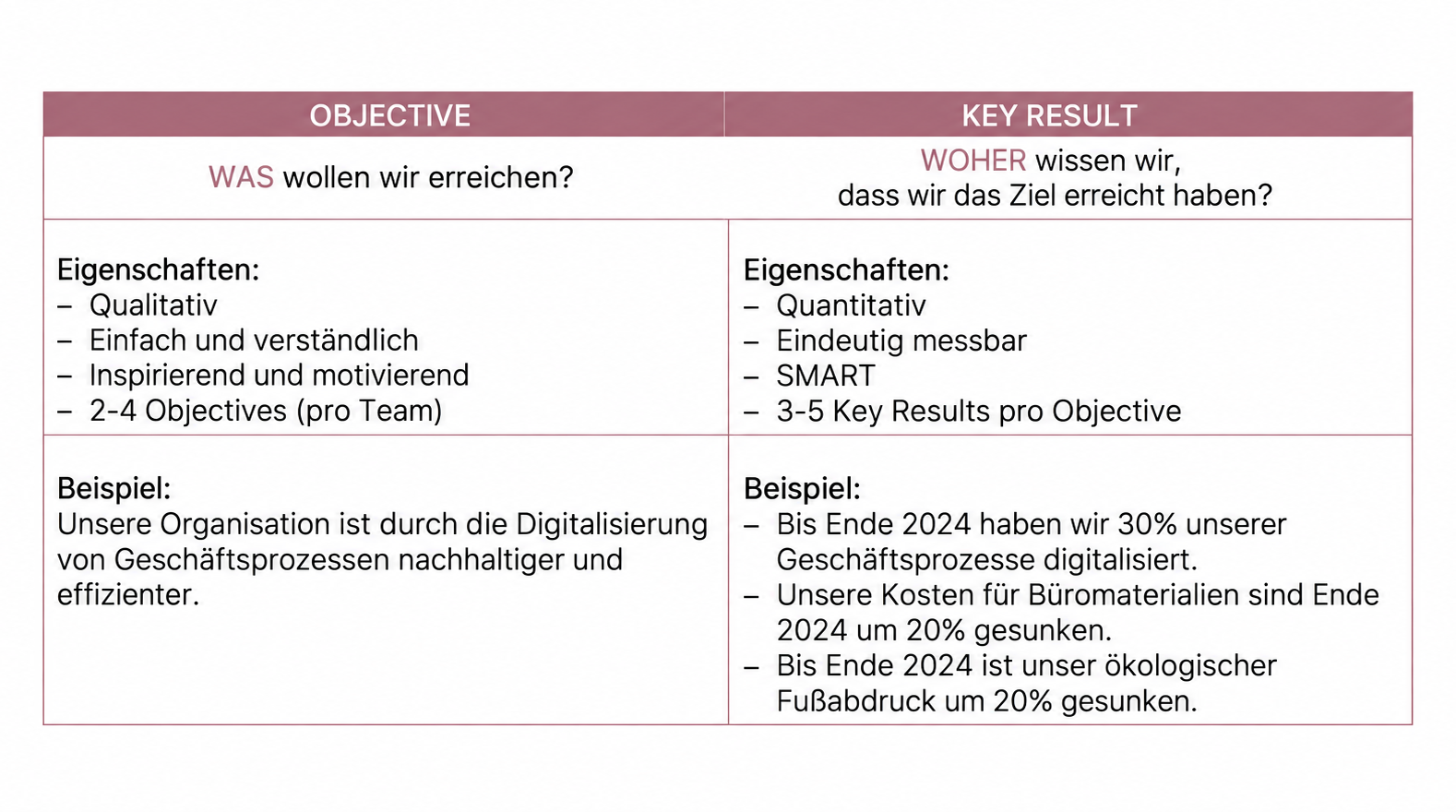
In principle, OKRs are derived from the overarching strategy or strategic initiatives. Compared to traditional long-term goal setting, OKRs typically look at 1-year goals, which are further broken down into quarterly goals at the team and/or department level. By translating strategic initiatives into OKRs, an important sense-making process occurs at the team level: What do strategic initiatives mean for the specific work within a team? A decisive factor for the success of OKRs is their formulation, which should happen within the respective team, as the team is responsible for fulfilling the Objective. An Objective generally represents a “value proposition” that should be formulated qualitatively and ambitiously. It is intentionally not measurable; it is far more important that there is a common denominator within the team. For each Objective, there are three to five corresponding Key Results that measure the progress or achievement of this value proposition (see example in table).
Mindset and Organizational Maturity Are Decisive
In addition to the process, it primarily requires the mindset and the maturity level of the organization to be able and willing to engage with agile processes and independent work in teams/departments. To be clear from the start: the introduction of OKRs represents an additional effort for the organization, especially in the beginning, as it must deal with breaking down strategic initiatives into concrete Objectives and Key Results alongside daily operations. Additionally, regular meetings are required to evaluate progress toward goal achievement and to intervene if necessary. This means that at the start of the introduction, a team or a few first-movers are needed who truly want to try something new and are eager to experiment and learn. Things do not always run smoothly at the beginning or in the pilot phase, but this offers immense opportunities to learn from challenges and mistakes for the next OKR cycle. Furthermore, it makes sense not to involve all employees in the OKR system from the very beginning to avoid overwhelming the organization.
Internal OKR Coach: A Vital Role
In every OKR process, there is an internal OKR coach—a central figure who builds significant knowledge regarding strategy implementation and OKRs. The OKR coach’s task is to support teams in formulating Objectives and Key Results and their measurement, managing OKR cycles, aligning goals across teams and departments, and moderating events. An OKR coach should be “neutral,” meaning not necessarily from the leadership team, to work together with teams on the effective further development of the OKR system: What worked, what worked less well, and how can we do it differently/better next time?
Why Should Companies Introduce OKRs?
Based on our previous consulting projects regarding OKRs and strategizing, we are convinced that OKRs are an important tool for making strategy a permanent topic in everyday business. By breaking down strategic initiatives into quarterly goals, teams work focused on fulfilling these in effective micro-steps. Systematic “procrastination” is thereby reduced—the internal OKR coach also ensures this. Furthermore, the OKR concept is suitable for better aligning goals across teams and departments. In addition to the OKR coach, who ensures transparency and alignment of goals across departments, regular OKR events are important for cross-team exchange. Working with OKRs also makes companies more agile and resilient. Through constant engagement with strategy as well as developments in the market environment (e.g., customer requirements, trends, etc.), organizations can react faster to changes. By formulating their own Objectives and Key Results, employees decide for themselves how they can and want to contribute to the implementation of strategic initiatives. This increases the perceived meaning of the strategy among employees and generates higher engagement in strategy implementation.
Working with OKRs can be a decisive success factor for the consistent implementation of corporate strategies. The beauty of this concept is that it can be relatively easily adapted to the mindset and maturity level of the organization—from low-threshold initiatives among a few “first-movers” to a full roll-out across the organization.